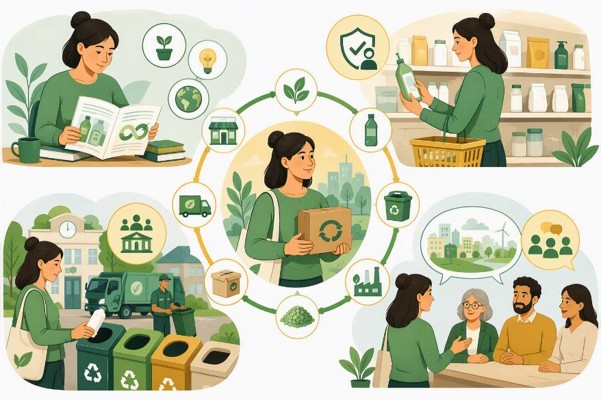
The transformation towards responsible packaging systems requires more than technological upgrades—it requires new skills, shared understanding, and the ability to collaborate across sectors and cultural contexts. As Lah (2025), highlights systemic disconnects between sectors and actors can undermine even the most promising sustainability initiatives. Because of this, the ResPa project embraces responsible packaging as a collective societal task that demands insights and cooperation across multiple communities.
Four Finnish circular packaging innovations representing three different circular economy strategies were discussed in the focus group (Figure 1). The first circular packaging solution was a refillable 0.5-litre spray bottle accompanied by two tablets, which, by dissolving them in water, results in 2 x 0.5-litre dose of detergent (rethink). The second one was Palpa deposit beverage bottle (PET) (Recycle), the third one was a fiber-based reusable shopping bag (Reuse), and the fourth one was a reusable e-commerce packaging (Reuse).
The used research method, focus group discussion, is defined by Barbour (2007) as follows: ‘A group convened for research purposes that relies on data on the discussion generated between participants.’ Focus groups are particularly suitable for exploring participants’ knowledge, experiences, and attitudes because the method uses group interaction to generate data and helps participants clarify their views through discussion (Kitzinger, 1995).
The focus group discussion was connected to two packaging RDI projects. The BioPak (Sustainable packaging solutions of the bio-circular economy) project aims at developing innovative take-back and reuse concepts of fibre-based packaging, with the consumer perspective in mind. This objective includes the development of resource-efficient wood fibre packaging and microplastic-free recycling processes. The ResPA (Consumers’ role in responsible packaging) aims at improving circular economy innovation capacities in packaging value chain actors and emphasize the consumer’s role in the circular economy.
The focus group discussion involved eight participants from Namibian higher education community representing both staff members and master’s level students. Although the group represented academically oriented residents of Namibia, it was underlined that in the focus group discussion they represented Namibian consumers. The discussion had a moderator and a note taker who used a pre-designed framework for picking up engagement expressions (motivator or driver for the consumer to use the solution as well as improvement ideas/suggestions), hindering expressions (something which makes the consumer question the solution), and other relevant remarks. The recorded discussion (47 minutes) was transcribed and the notes complemented by using both the recording and the transcription.
Staff and student exchange from Namibia to Finland were part of CircBioNam (Promoting circular bioeconomy in higher education by sharing and refining best practices in Finnish-Namibian collaboration) which is funded by Team Finland Knowledge (TFK) programme and ProCE (Finnish – Namibian Academy-Industry Consortium for Promoting Circular Economy) funded by Erasmus+ KA171. Both projects are implemented in Namibia and Finland 2025-2027.
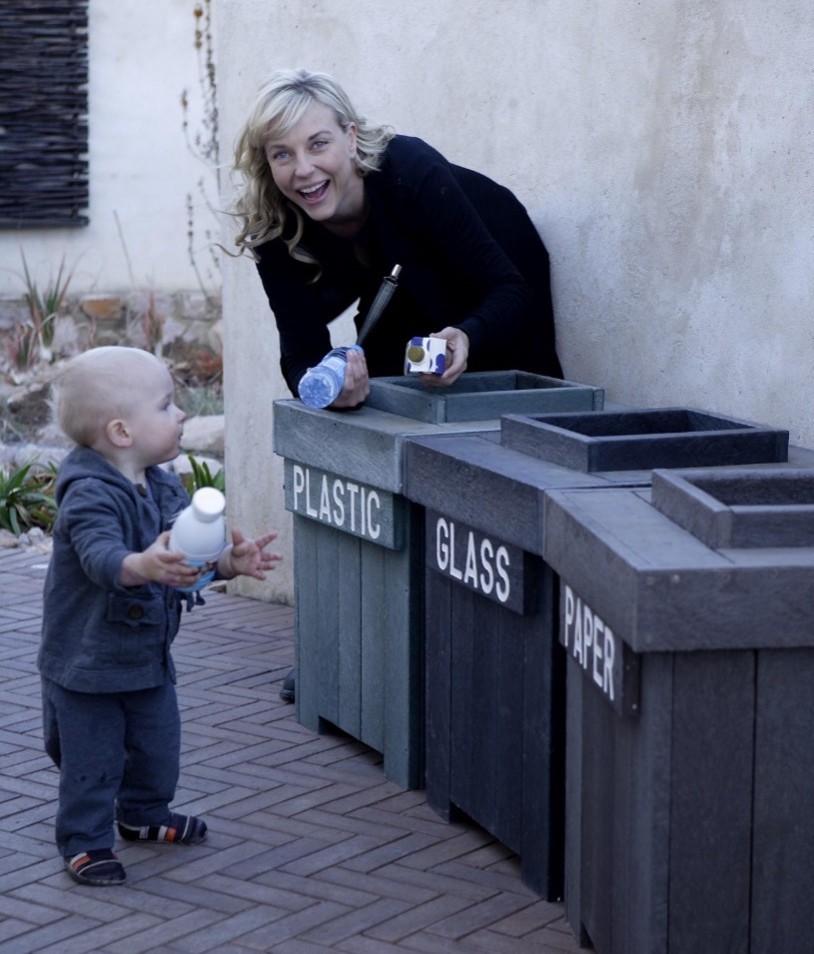
Image by Michelle Garforth Venter from Pixabay
References
Carayannis, E. G., & Campbell, D. F. J. (2009). ‘Mode 3’ and ‘Quadruple Helix’: Toward a 21st‑century fractal innovation ecosystem. International Journal of Technology Management, 46(3–4), 201–234.
Lah, O. (2025). Breaking the silos: Integrated approaches to foster sustainable development and climate action. Sustainable Earth Reviews, 8(1).
Vidal-Ayuso, F., Akhmedova, A., & Jaca, C. (2023). The circular economy and consumer behaviour: Literature review and research directions. Journal of Cleaner Production, 418, Article 137824. https://doi.org/10.1016/j.jclepro.2023.137824
Authors
Dr Maria Salomaa, Principal Lecturer, Innovation management

